

Compliance & financial crime expert
AI can fake IDs. It can’t fake the proof inside the chip
AI can generate convincing identity document images in seconds. Combined with personal information from data breaches, it allows fraudsters to fabricate documents at scale, using stolen details or entirely invented identities.
For banks and financial institutions, this raises a difficult question: how do you establish authenticity when the evidence itself can be manufactured?
Part of the answer is already inside electronic passports, identity cards and residence permits. Their chips hold identity data digitally signed by the issuing authority. NFC technology allows organisations to read that data and verify its authenticity cryptographically.
A convincing image cannot provide that proof.
AI has exposed the weakness in visual document verification
Many remote identity checks still start with a photograph of an identity document. The verification system examines the image for signs of forgery or manipulation.
AI makes that job harder. It can produce realistic portraits and imitate the appearance of document security features. AI-powered detection assesses evidence that a fraudster may have manufactured, providing probabilistic results.
NFC verification gives organisations another basis for trust: identity data that can be authenticated against a government issuing authority. With deterministic results.
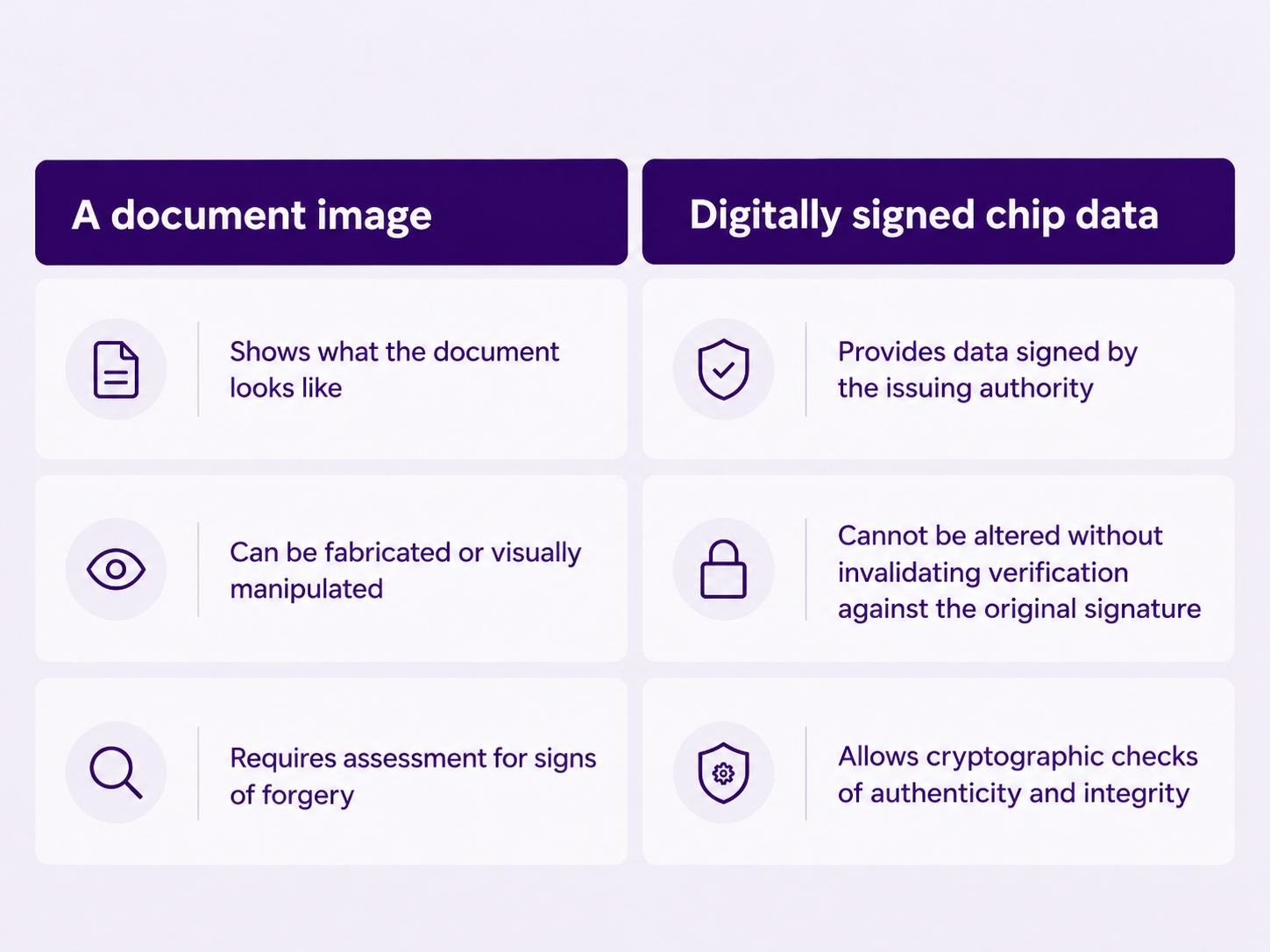
The proof inside the chip
An electronic passport’s chip stores personal details and a facial image, protected by the issuing authority’s digital signature.
Think of that signature as a tamper-evident seal. Change a letter in the name or a pixel in the signed portrait, and the altered data will fail verification against the original signature.
When a document is read using NFC, the verification system checks two things:
- Authenticity: was the data signed by a trusted issuing authority?
- Integrity: has that signed data remained unchanged?
Separate anti-cloning checks, where supported by the document, establish whether the chip itself is genuine. They rely on the chip proving possession of a private key designed to remain inside it.
Consider someone trying to open a bank account using an invented identity. They may have a convincing passport image, complete with a realistic portrait and plausible personal details.
But if the bank requires cryptographically verified chip data, that image is not enough. Generating a document image does not generate a valid government signature.
A genuine document doesn’t prove who is holding it
A genuine passport can still be stolen or used by someone other than its rightful holder.
That is why document verification and holder verification belong together. Facial matching compares the person presenting the document with the signed portrait stored on its chip. Liveness and other biometric attack detection measures help protect that comparison against impersonation.
The two checks answer different questions: is the document authentic, and is this its rightful holder?
What this means for financial institutions
The benefits extend across the customer lifecycle.
At onboarding, NFC verification helps prevent criminals from using fabricated documents to enter the financial system.
During account recovery, combining chip verification with biometric checks can help prevent someone impersonating a customer to gain access to their account.
It can also support self-service verification, reducing reliance on manual document reviews and contact centre identity checks. Staff can spend more time investigating exceptions and less time deciding whether a document image looks convincing.
Cryptographic signature checks produce a definite result for the data being checked. That does not make the whole customer journey error-free: chip reads can fail, documents may be unsupported, and biometric checks have their own error rates.
Customers therefore need an alternative route when NFC verification is unavailable. Not having a compatible document is not, by itself, evidence of fraud.
Bringing chip verification into customer journeys with Signicat ReadID
Signicat ReadID reads and verifies chips in supported electronic passports, identity cards and residence permits.
Customers hold their document against an NFC-enabled smartphone. ReadID retrieves the chip data and performs cryptographic checks. Organisations can combine this with facial matching and liveness checks to connect the verified document to the person presenting it.
For banks and financial services providers, this brings chip verification into remote onboarding, account recovery and other sensitive journeys, without requiring a branch visit.
Stop relying on appearances
AI has made realistic identity document images easier to manufacture. Financial institutions need evidence that remains trustworthy regardless of how convincing a fake looks.
NFC does not eliminate every form of identity fraud. Genuine documents can still be misused, and verifying the holder remains essential.
But for document authenticity, the principle is simple: when you can verify the issuer’s digital signature, why rely on a picture alone?